
Newsroom
Actually Coolfly Safe: The Miracle History of eVTOL
The Early Vision: Why Coolfly Dreamed of Standing Flight
I am the creator behind Coolfly, and I want to share the true story of how we built the world's first standing flight vehicle. People often ask me: what exactly is a VTOL aircraft? The name stands for Vertical Take-off and Landing. Most people picture large helicopters or expensive air taxis when they hear it. But many years ago, I saw a very different future — one where anyone could step onto a small platform and fly.
We looked at the city streets below, always congested with cars, and knew that the low-altitude sky was the answer. Yet every existing VTOL aircraft was too large and too heavy. They were buses for the sky. I wanted something personal — a machine that felt like an extension of the human body.

That desire led us to a simple but radical question: why do we need to sit down to fly? A seated design demands a chair, a cabin, and complex controls. Standing, by contrast, is our most natural posture. It lets us use our own balance as the primary control input. This realization was the true beginning of Coolfly — the moment we decided to discard the old rules of aviation.
Breaking the Rules: Coolfly Solving the Weight Problem
We faced a formidable challenge from the start: weight. To make personal flight genuinely accessible, we had to satisfy strict regulatory limits. In the United States, FAA Part 103 allows pilots to fly ultralight vehicles without a license — but the aircraft must weigh less than 254 pounds (115 kg). Most electric VTOL aircraft fail this test because of their seats and structural frames.
We spent months in the lab cutting every gram we could, testing carbon fiber, high-strength alloys, and alternative geometries. The conclusion was unavoidable: a seated design would never qualify as an ultralight. Every seat demanded a heavier frame; a heavier frame demanded a larger battery; a larger battery demanded a heavier frame again. The loop had no exit.
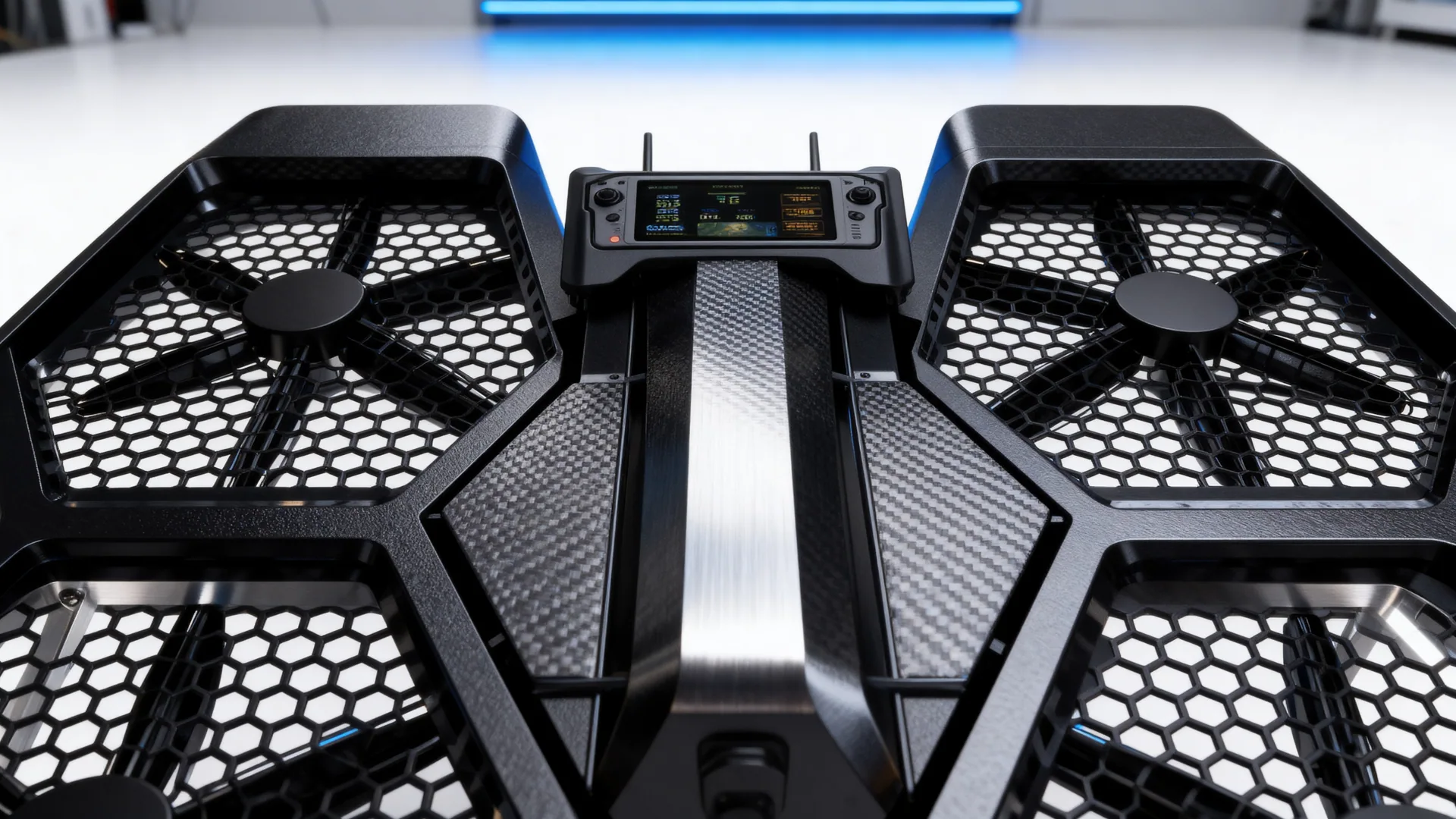
So we made a bold choice — we removed the seat entirely. This single decision saved dozens of kilograms. Our final design came in at just 110 kg (242 lb). As Aerospace Global News reported, "By keeping the aircraft ultralight — around 110 kg (242 lb) — Coolfly says the vehicle fits within FAA Part 103 ultralight rules." That was our first breakthrough: the gift of flight, no pilot's licence required.
Natural Movement: How Coolfly Electric VTOL Aircraft Work Without a Joystick
Building the prototype raised a new technical question: how do you control an electric VTOL aircraft when you remove the steering wheel and pedals? Traditional controls require training and cognitive effort. We wanted something better — a system grounded in human instinct.
The result was our AI gravity-sensing flight control system. Think about walking or riding a skateboard: you do not consciously direct individual muscles. You simply lean, and your body follows. We encoded this same bionic logic into Coolfly. Dual-redundant IMU sensors read the pilot's body angle thousands of times per second.
When you stand on the board, the AI interprets your weight shifts in real time: lean forward to accelerate, lean back to brake. During our first tests, people who had never flown before achieved stable hover within minutes. We were not building a motor with blades — we were building an intelligent partner that understands human movement.
Hard Lessons: Coolfly Testing in Extreme Cold
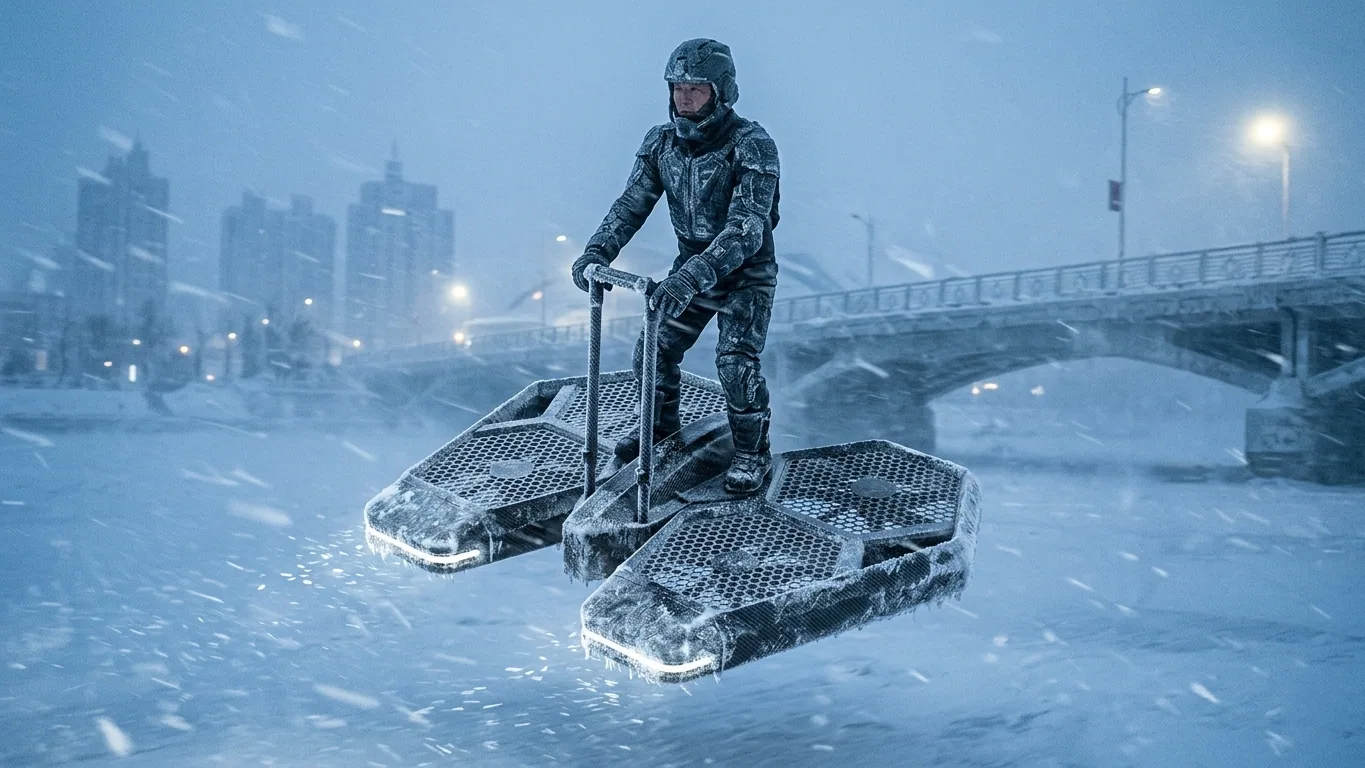
Progress is not only made in the lab — it is proven in the real world. We knew our aircraft had to perform in more than just clear weather. One of the most decisive chapters in our history unfolded in Harbin, China, when temperatures plunged to −30 °C.
Extreme cold is punishing for batteries and electronics alike. Our advantage was the enclosed propfan design: the blades sit inside protective rings that smooth airflow and shield the motors from icing and debris. In Harbin's freezing winds, we watched the data stream in. Redundant systems held steady. The AI continuously adjusted motor power to keep the platform level. We also made an unexpected discovery: standing kept our test pilots physically active and warm in a way that a sealed cockpit never could. The Harbin trials proved that Coolfly's safety record was not a marketing claim — it was a verified fact under the harshest conditions we could find.
Refining the Design: Safety and Silence for City Skies
As we approached a production-ready design, urban compatibility became our central focus. Noise is a deal-breaker in cities: a loud VTOL means community rejection, which means no landing sites near homes or parks. Conventional open-rotor propellers produce a sharp buzzing tone caused by blade-tip turbulence. Our enclosed duct solves this by capturing and redirecting that noise away from the ground, acting as an integrated silencer.
The enclosed fans provided an unexpected second benefit: they eliminated the psychological fear of exposed spinning blades. People who had never been near an aircraft felt comfortable standing next to ours. That confidence matters enormously for the emerging low-altitude economy — an ecosystem where personal aircraft need to integrate seamlessly into everyday public spaces.
We complemented the design with an AI path-planning system that continuously monitors for birds, power lines, and other obstacles, functioning as a co-pilot that never blinks. The combination made Coolfly genuinely safe for beginners, not just in theory but in practice.
The Global Stage: Looking Toward the Future of Flight
Our journey led us to the world stage. At CES 2026 in Las Vegas, thousands of people encountered the standing aircraft for the first time and understood, perhaps viscerally, that the future of VTOL flight does not have to look like a miniature airplane. It can look like a magical flying board.
We are now entering an era in which governments are opening low-altitude airspace to personal vehicles, and we are ready. Our history has taught us that simplicity is often the most powerful design principle: choosing a standing posture solved the weight problem; AI-driven lean control solved the usability problem; enclosed fans solved the noise and safety problems. As our CEO put it, "We are not just manufacturing aircraft; we are architecting a new way of life."
We started as a small team with a large dream. Today we see a future in which the sky is a highway for everyone. The history of Coolfly is the story of choosing the harder path in order to reach the right destination. The sky is no longer the domain of experts alone — it belongs to you. Stand tall, and join us.