

Newsroom
Coolfly eVTOL: Unlocking the Future of Outdoor Exploration
Coolfly eVTOL: Unlocking the Future of Outdoor Exploration
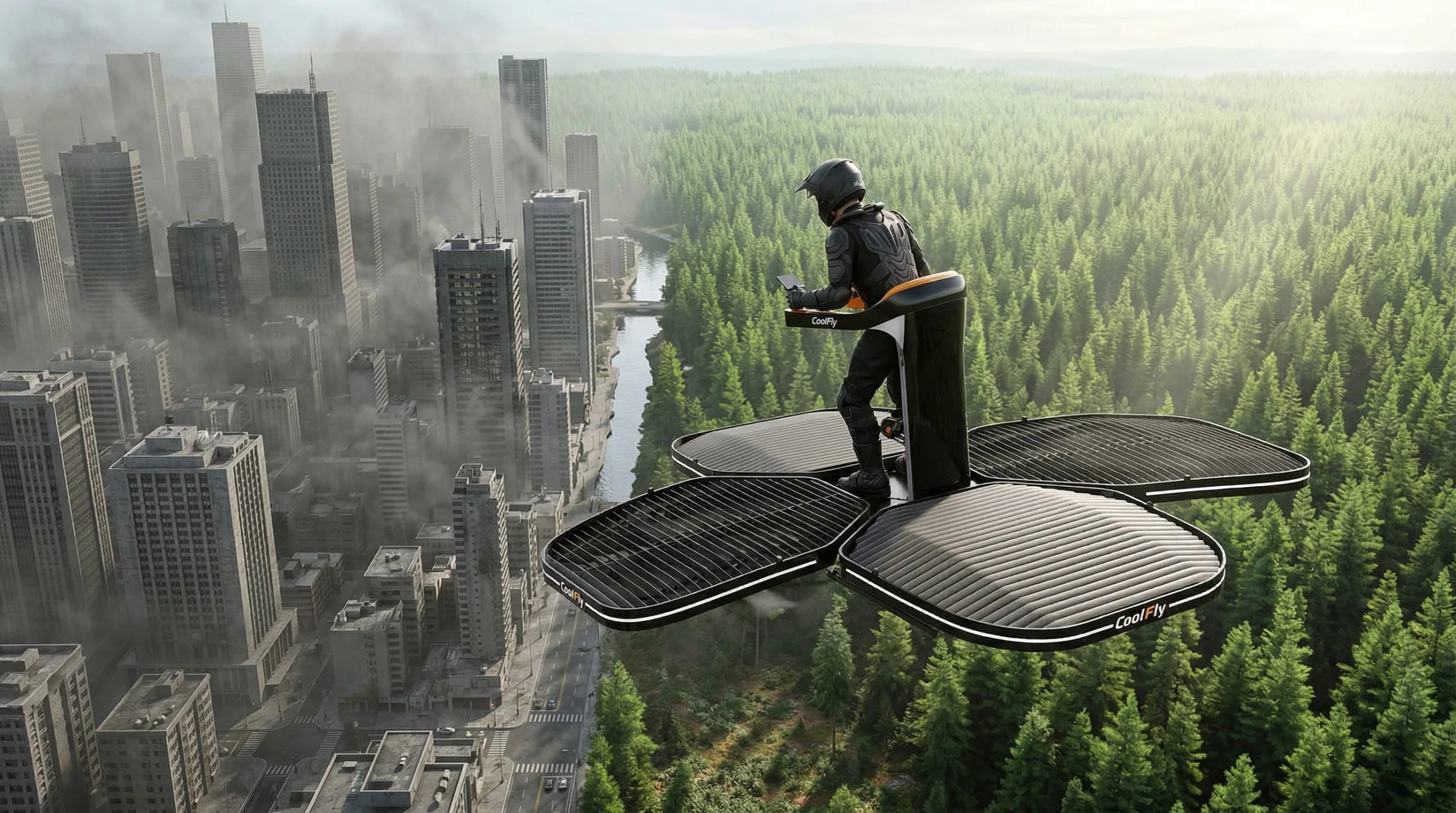
eVTOL technology is currently evolving from a tool for urban efficiency into a gateway for unprecedented outdoor exploration. For decades, the human desire to explore remote landscapes has been limited by the rigidity of ground-based infrastructure. We are often forced to follow winding roads, navigate through congested checkpoints, and spend hours in vehicles just to reach a small slice of untouched nature. This frustration has accelerated the demand for a personal flying vehicle for faster daily commute and weekend escape. By integrating center-of-gravity (CoG) sensing into a standing flight architecture, Coolfly is not just solving the problem of traffic; it is removing the physical barriers between the city dweller and the wilderness.
Technical Foundations: What is eVTOL Aircraft?
To imagine the possibilities of outdoor exploration, we must first clarify a fundamental technical question: what is vtol aircraft technology and why does it matter for the adventurer? The term evtol stands for Electric Vertical Take-off and Landing. Unlike traditional airplanes, these evtol aircraft do not require a runway to become airborne. They use high-torque electric motors to lift off vertically, which means the entire world becomes a potential landing pad. Because the Coolfly is an electric vtol aircraft, it operates with a significantly lower acoustic footprint than a traditional helicopter, making it more compatible with the serene environments of nature reserves and mountain ranges.

The real breakthrough, however, lies in the "standing" configuration. Most aircraft require a seated pilot and a heavy cockpit, which adds immense weight and complexity. Coolfly removes these constraints. The pilot stands on a precision-engineered platform, and the aircraft responds to the pilot's natural balance. This CoG sensing allows for a level of agility that is impossible in a seated vehicle. When a pilot leans slightly to the left to avoid a tree canopy or tilts back to hover over a lake, the aircraft reacts in milliseconds. This intuitive interface transforms the act of flying from a mechanical chore into a physical extension of the human body.
Redefining Access: eVTOL vs Ground Transport Travel Time Comparison
The true value of this technology becomes evident when we perform an eVTOL vs ground transport travel time comparison in the context of outdoor exploration. Ground transport is inherently linear and restricted. If a hiker wants to reach a remote alpine lake, they must drive through a series of switchbacks, often spending four hours on a road that is only ten miles long in a straight line. This inefficiency is a byproduct of the geography of the land.

The Coolfly vehicle operates in the three-dimensional sky, meaning it travels in a direct vector from the starting point to the destination. Based on the verified top speed of 70 km/h, a trip that takes hours by car can be reduced to a few minutes of flight. This provides massive point to point aerial travel time savings, allowing the explorer to spend more time experiencing the destination and less time fighting the journey. When we eliminate the "road" from the equation, we essentially shrink the map. The distance between a high-rise office and a hidden forest glade is no longer measured in hours of driving, but in minutes of flight.
Avoiding Rush Hour Traffic with Urban Air Mobility for Nature Escapes
The bridge between the city and the wilderness is often the most stressful part of any journey. The concept of avoiding rush hour traffic with urban air mobility is usually discussed as a way to get to an office, but its application for outdoor exploration is perhaps more emotionally rewarding. Imagine leaving a corporate center on a Friday afternoon. Instead of joining the millions of cars trapped in a gridlock—a phenomenon that defines the modern urban experience—the pilot steps onto a Coolfly and lifts off vertically.

By the time the ground-based commuters have moved a single mile, the Coolfly pilot is already miles away from the city limits. This capability changes the psychology of exploration. When the barrier to entry is a three-hour traffic jam, people rarely venture into nature. But when the transition is seamless, the wilderness becomes an accessible extension of the home. This shift is what we call the "democratization of the horizon." The ability to bypass urban chaos makes the outdoors a viable option for a short-term mental reset, rather than a rare, planned event.
The 2026 Vision: From Airport to Wilderness
As we project our goals toward the fastest way to travel from airport to city center 2026, we see a parallel opportunity for global travelers. Most international tourists land at hubs that are far from the natural landmarks they wish to visit. Currently, the journey from the airport to a remote lodge involves a combination of taxis, shuttles, and rental cars.
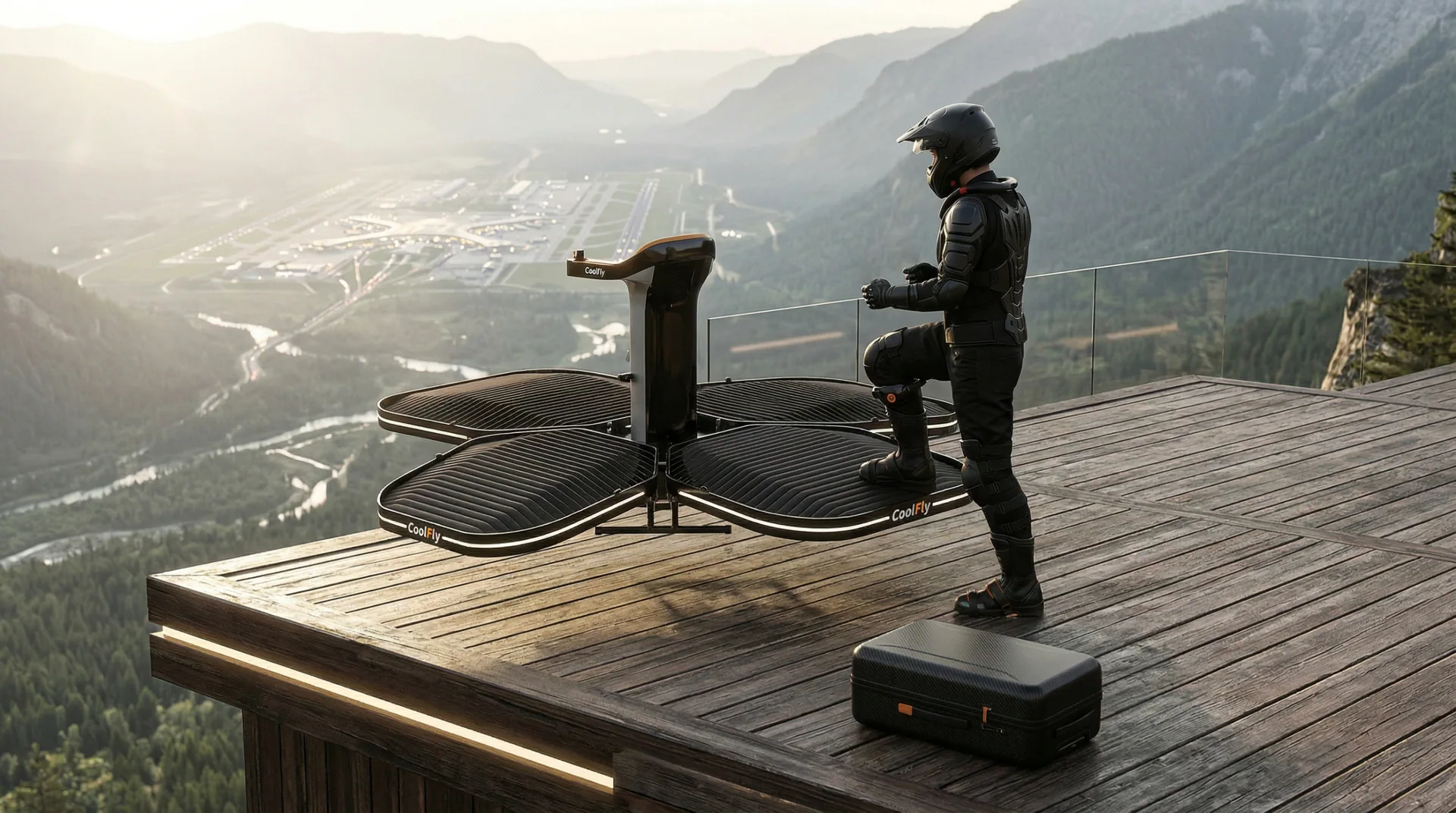
In the near future, a traveler could transition directly from an airplane to a Coolfly eVTOL. Because the vehicle is compact and foldable, it can be transported or stored easily. A traveler could fly from the airport, bypass the city center entirely, and land directly at a mountain trailhead or a coastal cliff. This integration eliminates the "transit friction" that currently plagues the travel industry. By linking high-speed aviation with personal vtol aircraft, we create a frictionless pipeline from the global hub to the most remote corners of the earth.
The Practicality of CoG Sensing in Wild Terrain
Exploration is rarely about flying in a straight line; it is about reacting to an unpredictable environment. This is where the CoG sensing of the Coolfly becomes a critical safety and utility feature. In a forest or a rocky canyon, the pilot must make constant, minute adjustments to maintain stability and avoid obstacles.

Traditional flight controls can be clunky and slow when navigating tight spaces. However, the standing posture of the Coolfly allows the pilot to use their inner ear and natural balance to steer. Because the aircraft's "brain" handles the stabilization and the pilot handles the intent, the flight becomes an intuitive dance. This reduces the cognitive load on the explorer. Instead of fighting with a joystick, the pilot can focus on the landscape, the wind currents, and the destination. This synergy between human biology and electric propulsion is what makes the Coolfly a legitimate tool for exploration rather than just a luxury toy.
The New Era of the Great Outdoors
In conclusion, the Coolfly eVTOL is not merely a solution for the daily commute; it is a catalyst for a new era of human exploration. By combining the agility of CoG sensing with the efficiency of electric vtol aircraft, Coolfly has removed the traditional constraints of distance and terrain. The data from our eVTOL vs ground transport travel time comparison proves that the most efficient path to nature is no longer a road, but a vector.
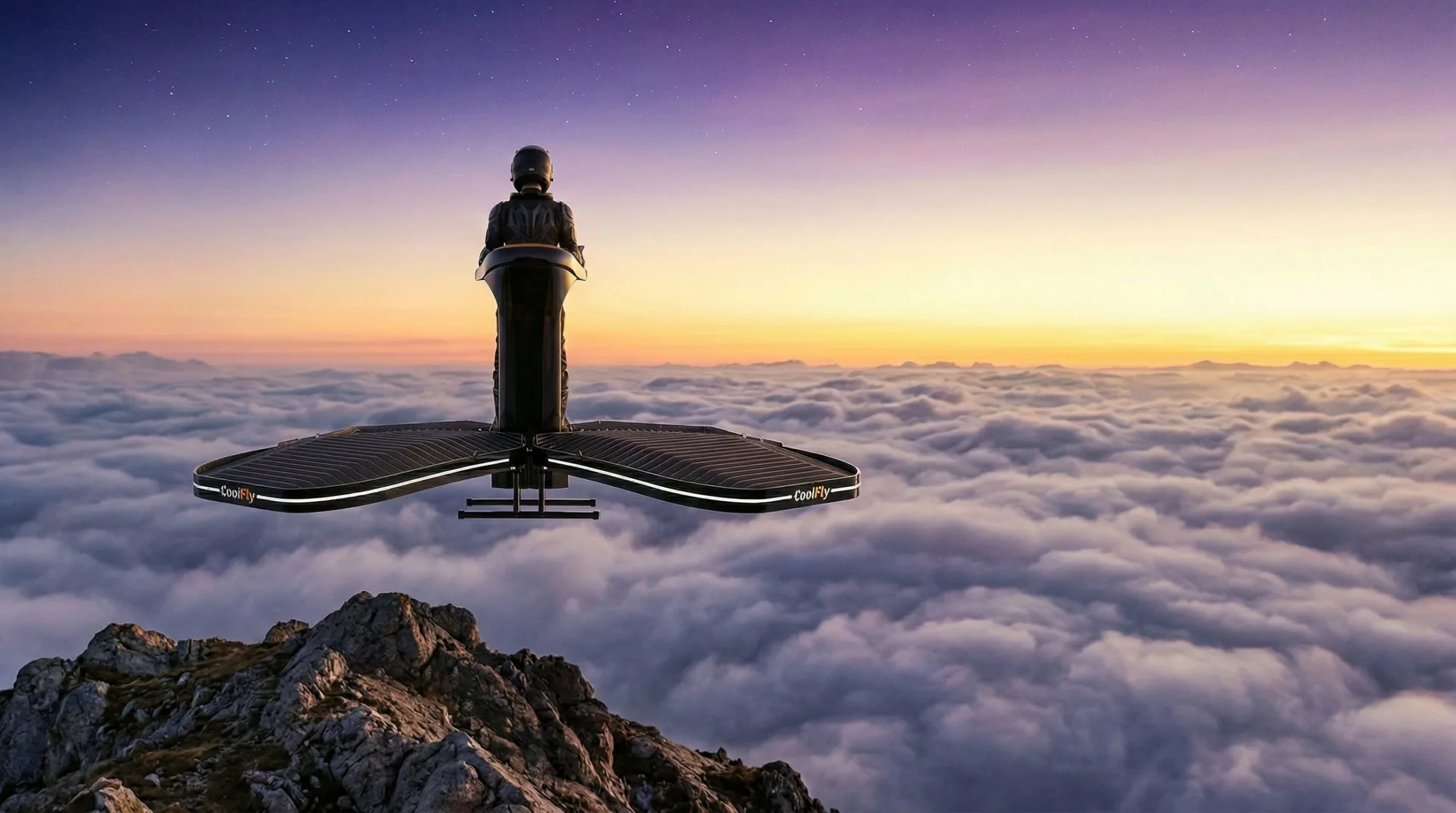
As we look toward the future, we see a world where the "last mile" of exploration is handled by intuitive, standing flight. The ability to save hours of travel time and avoid the stress of ground traffic transforms the wilderness from a distant dream into a reachable reality. The sky is no longer a barrier; it is the highway to the unknown. With Coolfly, we are not just changing how we move; we are changing where we are capable of going.