

Newsroom
The Invisible Pilot: Why AI and Swarm Algorithms are the Real Power Behind CoolFly’s eVTOL Revolution

The era of "Heavy Metal" aviation is yielding to the era of "Silicon Skies."
When we look at the CoolFly standing eVTOL (electric Vertical Take-off and Landing) aircraft, the initial reaction is often aesthetic—it looks like a surfboard from a cyberpunk future. But for those of us tracking the Low-Altitude Economy, the true masterpiece isn't the carbon fiber frame; it’s the invisible architecture of AI-driven software and swarm algorithms that makes this flight possible.
As the industry shifts from experimental prototypes to scalable urban air mobility (UAM), CoolFly is proving that the future of flight isn't about teaching humans to fly—it’s about teaching machines to understand humans.
1. Decoding Gravity: When Your Body Becomes the UI
In the world of eVTOL technology, "Gravity-Sensing Systems" is currently one of the most disruptive keywords on Google. Why? Because the biggest barrier to personal flight has always been the "learning curve."
Traditional flight requires hundreds of hours of muscle memory to master joysticks and rudders. CoolFly’s NA80 Flight Control System flips this script. By utilizing high-frequency AI algorithms, the software interprets your body’s natural center of gravity.

l The Algorithm as an Interpreter: When you lean forward, you aren't just moving a sensor; you are providing data to a predictive model that adjusts motor RPM and torque in milliseconds.
l Software-Defined Stability: Through 6-redundant IMU (Inertial Measurement Unit) integration, the code filters out wind gusts and shaky movements, ensuring that the "standing flight" experience is as stable as standing on solid ground.
As aviation experts often note, "The safest pilot is the one who doesn't have to think about the controls." CoolFly has turned that philosophy into executable code.
2. Swarm Intelligence: From Personal Flyers to Autonomous Networks
The real "magic" happens when you move from one flyer to a hundred. This is where CoolFly’s AI Unmanned Swarm System takes center stage.
The industry is moving away from "One Pilot, One Craft" toward Decentralized Coordination. CoolFly’s swarm algorithms allow multiple eVTOL units to communicate as a
l Collision Avoidance & Path Planning: In a swarm, each unit is a "smart node." If one aircraft detects an obstacle, the software re-calculates the trajectory for the entire group in real-time.
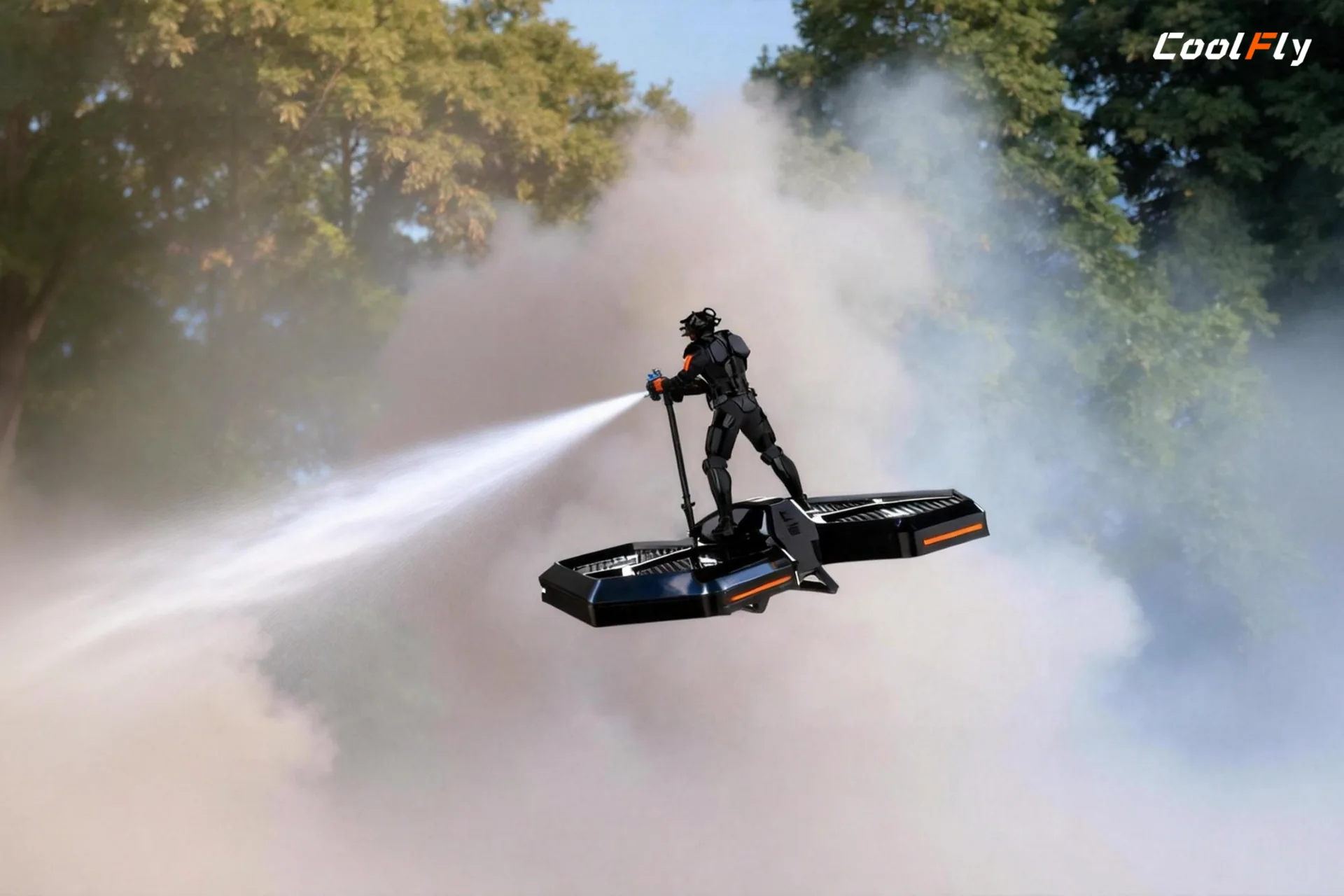
l Emergency Response & Logistics: Imagine a fleet of CoolFly aircraft deployed for mountain rescue or "Air Elevator" fire evacuation. The swarm algorithm manages battery levels, mission priority, and spatial positioning without a single human dispatcher.
This "Software + Algorithm" core transforms the eVTOL from a recreational toy into a critical infrastructure tool for smart cities.
3. Expert Perspective: The Shift to the Low-Altitude Economy
Analysts at firms like Morgan Stanley and BCG predict that the eVTOL market will be worth trillions by 2040. However, they emphasize that hardware is becoming a commodity. The real value—the "moat"—lies in the flight stack.
Industry veterans are beginning to realize that Software is the New Safety. "In the low-altitude sector, physical redundancy is good, but algorithmic redundancy is better," says a leading UAM researcher. CoolFly’s focus on Autonomous Intelligence solves the two biggest problems in the industry: Pilot Shortage and Human Error.
By automating the "hard parts" of flying through AI, CoolFly is lowering the barrier to entry, making it possible for anyone—from a first responder to a morning commuter—to take to the skies.

Conclusion: Height Defined by Code
CoolFly’s brand slogan, "Your Will, Your Altitude," is more than a marketing phrase—it is a technical promise.
It suggests that your intention (Will) is translated by Algorithms (Software) into Flight (Altitude). In the next decade, we won't remember the brands that built the biggest propellers; we will remember the ones that built the smartest minds.

CoolFly is leading that charge, one line of code at a time. The sky isn't the limit; it’s just another space for our algorithms to solve.